Visiting an old Capone hang out

Finding Al host Leon Willey outside the Green Mill Cocktail Lounge in Chicago.
Photo by Thomas Bartlett
The Finding Al crew visited Capone's old hangout in Chicago, the Green Mill Cocktail Lounge, to see if anyone there might have heard about the gangster's Canadian connections. 

During the Prohibition era, Jack McGurn of Al Capone's Chicago Outfit was a part-owner. 

Capone's favorite booth is still there, directly west of the short end of the bar. The booth afforded Capone and his men clear views of both the front and back entrances to the establishment. 

It is rumored there is still an access hatch to the tunnels located directly behind the long end of the bar that leads underneath the street to an adjacent building; which would have allowed Capone a quick escape if the authorities paid a visit to the Green Mill. 

Today, the Green Mill is known for its jazz and poetry performances, along with its connections to Chicago mob history. 

Originally named Pop Morse's Roadhouse, the business opened in 1907. It was renamed Green Mill Gardens a few years later, a nod to the famous Moulin Rouge ("Red Mill") of Paris.

In its early years, it was a popular hangout for movie actors from nearby Essanay Studios. The namesake gardens were removed in the 1920s during the construction of the Uptown Theatre on the same block. 

After the end of Prohibition, the Green Mill became a more reputable establishment, attracting many popular jazz acts. 

Singer and comedian Joe E. Lewis was attacked by McGurn's men in 1927 after he refused to take his act to the Green Mill. Lewis' throat was slashed, but he survived. The incident inspired the 1957 film The Joker is Wild. 

The business began to struggle in the 1970s, but was revitalized with a new owner in the 1980s. 

In 1986, the Green Mill became home to the Uptown Poetry Slam. 

For those of you who have never been, the Green Mill Cocktail Lounge is on Broadway in Uptown, Chicago. 

Over the years, the Green Mill has appeared in many films, such as Thief (1981), Next of Kin (1989), V. I. Warshawski (1991), Prelude to a Kiss (1992), Folks! (1992), Soul Food (1997) and High Fidelity (2000).

And soon it will get a mention in Finding Al.

Minot, the Magic City

Finding Al host Leon Willey in Minot.
Photo by Thomas Bartlett
Minot, like Moose Jaw, became known as a “Little Chicago.”

Minot, also known as the Magic City, was a centre for Al Capone’s rum-running operations, linking the liquor supply in Canada with the demand in America.  

Many bootlegging tales focused on the roads around Minot.  

The highway between Minot and Saskatchewan was especially poor in the 1920s, but the border between the U.S. and Canada wasn’t as scrutinized as the borders out east in more densely populated areas.

It is said Minot might have also had tunnels too, used to keep illegal activity underground.

Minot, why not?

Did Al Capone visit Manitou Beach, Saskatchewan?

The "Finding Al" crew recently traveled to Manitou Beach, Saskatchewan to investigate a tip that Al Capone was in that area.

We heard stories that suggested it might have been possible. Manitou Beach was a popular tourist destination back in the 1920s. Thousands of people used to travel to Manitou for its healing waters and the world famous Danceland.
Manitou Beach, SK
Many people from Moose Jaw owned cottages in the area, including Moose Jaw's infamously corrupt police chief Walter P. Johnson who turned a blind eye to rum running and prostitution.

Rumour has it that Johnson provided refuge for gangsters on the lam, like Al Capone. Maybe he took Capone to visit his cottage at Manitou, which was a wild place during the 1920s. The woods around Manitou Beach area were spotted with rum running and illegal stills. Like Moose Jaw, it was quite the party town.

Inside Danceland
Photos by Thomas Bartlett
Manitou Beach was appealing to tourists because its waters have a specific gravity 10 per cent higher than regular water due to a greater concentration of dissolved salts and minerals. The added density greatly enhances buoyancy and make it impossible for people to sink - even when motionless. The minerals in the water are therapeutic in a variety of ways. Dependent upon mineral deficiencies, the body draws minerals right through the skin itself. Conversely, the water draws minerals within the body to the surface of the skin. This in combination with weightlessness relieve pressure from muscles and joints, cleanse and heal the skin, relieves stress and generally work in a holistic way to heal the body. 

This would have made Manitou Beach the perfect place for Johnson to take Capone. After all, a gangster, like Capone, would have been under a lot of pressure back then and would have needed a place to relax.


Spend a day in Moose Jaw, meet a Capone

Spot Al Capone in Moose Jaw
Photo: Thomas Bartlett
Deirdre Capone, grandniece of Al Capone, will be in Moose Jaw on August 27 giving a talk about her memories about her Uncle Al at the Mae Wilson Theatre at 7 p.m.

For those of you coming in from outside of Moose Jaw to hear her talk, here are some of Finding Al producer Kelly-Anne Riess' top 10 things to do while in town, if you're thinking of making a day trip.

1. Check out the Burrowing Owl Interpretive Centre - Cute little owls that live in gopher holes on 250 Thatcher Drive East. The Burrowing Owl Interpretive Centre is dedicated to species at risk conservation.  Come meet some critters and learn more about prairie conservation.

2. Take the Moose Jaw Trolley - This tour covers all aspects of the city – must see attractions, heritage buildings and residential properties and a sampling of the city’s 40 plus murals. Purchased in 1999, the Moose Jaw Trolley quickly became a fav orite attraction. The 34 seat trolley is a replica 1911 electric streetcar, which today operates on propane. Daytime tours leave from the Visitor Centre on Thatcher Drive (beside Mac The Moose).  The trolley departs daily at 1 p.m., 2:15 p.m. and 3:30 p.m. 

3. The Temple Gardens Mineral Spa - Enjoy the geo-thermal waters of the interconnected indoor and outdoor pools. It's worth it. 

Photo: Thomas Bartlett
4. Moose Jaw Museum & Art Gallery - An impressive museum where history and art meet. (In the same building as their library at 461 Langdon Crescent). While there, visit the neighbouring Crescent Park. Take a stroll along the creek and watch for swans and mallards. Need more fresh air, go to the Wakamow Valley and check out the Moose Jaw River.

5. Sukanen Ship Pioneer Village & Museum - Ever hear that story about that Saskatchewan  guy who built a ship in Saskatchewan so he could sail home to Europe. He was committed before he could make the journey, but the ship can be seen at the Sukanen Museum, which started as an automobile club in 1961 and soon grew to include authentic pioneer buildings, that includes the Diefenbaker homestead and a full-size grain elevator. Don't forget to check out their historical hazmat suit collection, which is spectacular. It's located 13 kilometres south of Moose Jaw on Highway #2.

5. Western Development Museum - Planes, trains, cars, boats and 100 years of Saskatchewan on 50 Diefenbaker Drive.

6. Eat at DK Sushi on 224 Main St. N. It's the best sushi you will ever have. You will often find the "Finding Al" crew there. 

7. Don't like sushi, try the Mad Greek on 925 Main St N. Try the Greek fries.

8. Just want a cup of coffee, Coffee Encounters (203 Main St N) and Java Express (23 Main St. N) are both great.

9. Visit Post Horizon Booksellers - Looking for a rare book or something fun to read on the drive home. This used bookstore, on 57 High Street West, is amazing. The owner and bibliophile Nelson Reid, specializes in rare books. He remembers the very first sale: a biography of John Wayne, sold to a collector. Since then, collectors have taken home many other treasures: one of three known copies of a Canadian cookbook from the late 1800s, the first printing of a journal of exploration by a contemporary of Lewis and Clark, the exhaustive catalogue of Canadian Pacific Steam Locomotives that went to Finland, and the early Oz editions that went home to Kansas.

Mac the Moose
Photo: Thomas Bartlett
10. The Tunnels of Moose Jaw - An award winning attraction, on 18 Main St N, that blends history and entertainment in our presentation of two diverse periods in Canadian history. You will be taken on a journey by their guides and become part of that history. In the Chicago Connection Tour, you're bootleggers in 1929. You come to Moose Jaw to buy booze from the Capone organization. You've got to learn the ropes and stay out of the way of the local police chief. You start out at Miss Fanny's club and end up in a tunnel, somewhere underground. And the only one who knows the way out is Gus, one of Capone's goons. The Passage to Fortune tells the story of early Chinese immigrants to Canada. You become an immigrant and follow in their footsteps through Burrows and Sons Laundry, in darkened tunnels under the streets and in the kitchen of Mr. Wong's cafe. Your passage to fortune is just around the corner. 


Deirdre Capone to visit Moose Jaw

Deirdre Capone, grandniece to Al Capone, will be coming to Moose Jaw in August to be interviewed for Finding Al.
Deirdre Capone
In talking to her briefly over the phone, the Finding Al crew has learnt her uncle used to call the Canadian prairie God's country because of the big open skies, among other stories.

While in Moose Jaw, Ms.Capone will be giving a public talk at the Mae Wilson Theatre Moose Jaw Cultural Centre on Tuesday, August 27 at 7 p.m.

She will be sharing family stories about her great uncle Al Capone and showing pictures from the family album.

Ms. Capone's grandfather was Ralph Capone, listed in 1930 as Public Enemy #3 by the Chicago Crime Commission. This makes Deirdre the grandniece of Public Enemy #1, Al Capone.

One of the stories in Ms. Capone's memoir, Uncle Al Capone: The Untold Story from Inside His Family, is about how her grandmother Theresa used to bake cookies for Al and his gang, who absolutely loved Theresa's baking. In the back of Ms. Capone's book is a recipe for these "Mob Cookies." 

For much of Ms. Capone's life, she did not readily volunteer she was a Capone. She made every effort to hide her family history, leaving Chicago in 1972. It wasn't until she had grandchildren that she decided to share her family story and write a book about her experiences. 

After Ms. Capone's talk, audience members will have the chance to meet meet Ms. Capone and have her sign a copy of her memoir: Uncle Al Capone: The Untold Story from Inside His Family.


"A lot of people think Al Capone was a psychopath. A lot of people think Robert DeNiro captured the true nature of America's most notorious gangster. A lot of people seem hell bent on clinging to a bunch of mythology that plain and simple makes no sense," said Jonathan Eig, author of Get Capone. "Deirdre Marie Capone is not one of them. With this lovely, personal, heartfelt story, she takes a stand. She's not nominating Capone for sainthood. She's not asking you to pardon him his crimes. She's simply and honestly telling the story she knows best--the story of her family."

Following Ms. Capone's talk, people can see a sneak preview of  the Finding Al - A Documentary.

Tickets are $20 at the Moose Jaw Cultural Centre box office only. 

Proceeds go towards supporting Ms. Capone's visit to Moose Jaw and the Mae Wilson Theatre's regular programming. 

Attending this event is a great way to support Saskatchewan film and artistic programming in Moose Jaw.

This event is general seating.

The bootlegger caves of Roche Percee

The "Finding Al" crew took a drive out to Roche Percee to check out the caves where bootleggers are said to have hid their alcohol. 

Deirdre Capone, the grandniece of Al Capone, said she heard about these caves growing up. The Soo Rail Line, which Al Capone was rumoured to take, connected Chicago to Roche Percee up to Moose Jaw. The establishment of this rail line helped the coal industry take off in the Roche Percee area. 

Before the rail line was established, coal was shipped by barge down the Souris River, to the Assiniboine River, and onto Winnipeg. Underground operations began to give way to surface “strip” mining by electric shovels in the 1930s. As such, a lot of the original landscape around Roche Percee has been destroyed and resurfaced with new grassland. Today, there are only two companies mining coal in the area.

In 2011, flooding on the Souris River inundated the approximately 162 residents of Roche Percee, forcing its residents to evacuate. Over half of the 64 homes in Roche Percee were damaged beyond repair, and had to be demolished.
When the "Finding Al" crew was there, the village was in the process of being rebuilt. Some people were housed in temporary trailers as their homes were being reconstructed.

One woman is rebuilding her house on stilts, so if the river ever floods again, she will not be affected by the rising water.

Roche Percee is a 10-minute drive away from Estevan, just off Hwy 39. It is located in the beautiful Souris River Valley near the American border.

In 1874, the North-West Mounted Police established the Short Creek Camp at Roche Percee.

Referred to by local residents as "The Rocks," it has large sandstone deposits in which some caves have formed. The name of the village comes from the Métis name of the rock formations, which means "pierced rock" in French.

Photos of Roche Percee by Thomas Bartlett


Little Chicago

Photo by Thomas Bartlett
When thinking about Al Capone's base of operations, one cannot help but think of the famous poem "Chicago," by Carl Sandburg, first published in 1914. 

This poem could have been easily describing Moose Jaw back in the 1920s, which was then described by a newspaper reporter as being a "God-damn virus for which there is no cure."

The reporter was referring to the prostitution, the police corruption, the drinking and gambling that went on in Moose Jaw back then.

Chicago
BY CARL SANDBURG


Hog Butcher for the World,
   Tool Maker, Stacker of Wheat,
   Player with Railroads and the Nation's Freight Handler;
   Stormy, husky, brawling,
   City of the Big Shoulders:

They tell me you are wicked and I believe them, for I have seen your painted women 
   under the gas lamps luring the farm boys.
And they tell me you are crooked and I answer: Yes, it is true I have seen the gunman 
   kill and go free to kill again.
And they tell me you are brutal and my reply is: On the faces of women and children I 

   have seen the marks of wanton hunger.
And having answered so I turn once more to those who sneer at this my city, and I give 

   them back the sneer and say to them:
Come and show me another city with lifted head singing so proud to be alive and coarse 

   and strong and cunning.
Flinging magnetic curses amid the toil of piling job on job, here is a tall bold slugger set 

   vivid against the little soft cities;
Fierce as a dog with tongue lapping for action, cunning as a savage pitted against the 

   wilderness,
   Bareheaded,
   Shoveling,
   Wrecking,
   Planning,
   Building, breaking, rebuilding,
Under the smoke, dust all over his mouth, laughing with white teeth,
Under the terrible burden of destiny laughing as a young man laughs,
Laughing even as an ignorant fighter laughs who has never lost a battle,
Bragging and laughing that under his wrist is the pulse, and under his ribs the heart of 

   the people,
Laughing!
Laughing the stormy, husky, brawling laughter of Youth, half-naked, sweating, proud

   to be Hog Butcher, Tool Maker, Stacker of Wheat, Player with Railroads and Freight 
   Handler to the Nation.


Photo by Thomas Bartlett

Clowning around with Lee Bellows

Lee Bellows in Moose Jaw
Photo: Thomas Bartlett
The crew of "Finding Al" crossed paths with professional rodeo clown Lee Bellows.

 Lee,  grew up in Moose Jaw, said his father used to say that drinking in prohibition was more fun, because you weren't allowed to . . . 
"It's funny.  You used to go outside to have a drink and you'd come inside to smoke. It's completely reversed now," he said.
His mother spent most of her adult life trying to keep his father off of River Street in Moose Jaw. 
"I grew up around the stockyards in Moose Jaw and remember stories about an old American who bought the smallest little plain cattle that he could, and sent them on the Soo Line south," said Lee. "The story was that he put those little cattle in box cars that had false bottoms and lots of straw in them, and smuggled barrels of whiskey during prohibition." 

Poet Bob Currie on Al Capone


Robert Currie at his house in Moose Jaw.
Photo: Thomas Bartlett
Robert Currie, former Saskatchewan Poet Laureate and long-time Moose Jaw Resident, wrote a poem called "Al Capone in Moose Jaw," which he shared with the "Finding Al" crew during a recent visit to the Friendly City. The poem is from his book Witness and is dedicated to Bob's former high school classmate Nancy (Beamish) Gray whose father is said to have cut Capone's hair on more than one occasion.

Bob said the poem was also partly inspired by the gangster movies he used to see when he was a kid.

"Every time some guy went into a barber shop, they’d put a towel across his face and outside the door, Tommy guns would open up and riddle the whole place, so I’m sort of playing off that a bit in this poem," said Bob. 

Other than hearing Nancy's story in school, Bob said no one really thought very much of Capone at all.

"But it kind of makes sense," said Bob about the Capone-Moose Jaw connection. "The Soo Line does come right up from Chicago and you know back in the day there was a certain amount of rum running and going out of Canada and into the States, so who knows."

Below is his poem, reprinted with his permission.  

Al Capone in Moose Jaw 

For Nancy (Beamish) Gray    

More than once I left Chicago far behind,

fled the heat, the rub of life along the lake.

I slipped away, up the Soo Line into Canada,

stepped down, a burst of steam, took the tunnel

underneath the tracks, rose beneath the bright arch

of the division point station, found River Street

awash with rum and willing women, policemen

already trained to look the other way. Oh, sure,

I might have had an itch to dominate that action,

but this was small-time stuff, Chicago was my town.
 

What I liked up here was Overs’ Barber Shop,

walking in alone, no one with me, not a man,

dropping into that great leather chair, clean-cut

Bill Beamish washing my hair, drawing damp strands

between the first and second fingers of his left hand,

the snep, snep of the scissors in his right, ahh,


settling deep into that chair, eyes closed, purrrr

of clippers on my neck, then the razor

by my throat, and no gun in my pocket,

snick, snick, snick, the sideburns squared away,

the sudden splash of Rum and Quinine Tonic,

the tingle on my scalp, fingers rubbed it in,
 
massaged the muscles of my neck,
worked above my ears, across my forehead,

zzzz, a hive of bees at peace, a comb, perhaps,

a brush, something passed across my head.
 
Ah yes, more than once I had my hair cut there.

Visiting the Moose Jaw train station

The Moose Jaw Train Station
Saskatchewan Archives R-A3374
This was the Moose Jaw train station in the 1920s.


It is said that some people used to smuggle alcohol in and out of Moose Jaw at the bottom of train cattle cars.

According to fact or fiction, tunnels were built from the former CP Rail station on Manitoba Street to the Cornerstone Inn across the street. A secret above-ground entrance behind the Cornerstone Inn was the hub of a network of tunnels that included one directly across Main Street to the former Exchange Cafe, once one of Saskatchewan's finest dining establishments. Other tunnel links went north up Main Street and west along River Street to the Royal George and Brunswick Hotels.

The train station was designed by Hugh G. Jones and built by the Canadian Pacific Railway from 1920 to 1922, so it would have been a fairly new building when Capone went through it. The station had a two-story waiting area, a four-story office block and a six-story Tyndall stone clock tower.

The Cornerstone Inn is rumoured to be connected to the train station via a tunnel.
The station was a stop on the Canadian Pacific Railway service and was a transfer point to the Minneapolis, St. Paul and Sault Ste. Marie Railroad also known as the Soo Line Railroad, which operated from Saint Paul to Portal, North Dakota.

There was also the Soo-Pacific, which ran during the summer, through to Vancouver via a connection with Canadian Pacific Railway's "The Dominion" at Moose Jaw. This was discontinued in 1963.

The building was designated a historic railway station in 1991.

Alcohol was American as apple pie.

Library of Congress

For most Americans, before Prohibition, alcohol was American as apple pie. 

The Mayflower hold was filled with beer. 

John Adams began each day with hard cider. 

George Washington made sure his men had half a cup of rum everyday. 

Thomas Jefferson dream of fine American vineyards. 

Young Abraham Lincoln sold liquor by the barrel from his grocery store. 

Fredrick Douglas said liquor made him feel like a president--self-assured and independent.

Physicians said alcohol was far better for people than waters hauled from muddy rivers.

Clergy men drank as part of their ritual celebrations.

Cited from Ken Burn's documentary Prohibition.

Driving into the past . . .

The Western Development Museum in Moose Jaw has a great collection of 1920s cars. We took Leon Willey there to do some of his hosting for "Finding Al."

While at the museum we had a chance to check out the history of land travel in Saskatchewan.

There are over 40 cars and another 16 trucks, from a 1902 Holsman rope drive car that looks more like a buggy, to a Ford Model T, which was “the car that put America on wheels.” 

There are also all kinds of contraptions for winter travel, motorcycles, even a Citroën half-track that made a trip through the British Columbia wilderness in 1934 on the whim of a French-American millionaire, carting much-needed trail supplies, like cases of champagne.

If you haven't been to the Western Development Museum before, you should check it out.

Vote Dry

Vote Dry Poster
The researchers of "Finding Al"had a lot of fun at the Saskatchewan Archives. They found a ton of old photos of Moose Jaw in the 1920s, old prohibition cartoons and more about the Woman's Christian Temperance Union than anyone would want to know.

The WCTU, which was founded in 1873, still exists today. Although its membership peaked in the 1920s. (But there aren't any pictures in SK Archives from that decade. Lots of pictures from the 1960s though). 

To become a member of the WCTU one has to sign a pledge of abstinence from alcohol.

Machine Gun History

In the Tunnels of Moose Jaw.


Some of the interesting stories heard while filming "Finding Al" are those about gangster farmers in Saskatchewan, who would have wild parties on the land, firing submachine guns into the air. Now that's a great part of Saskatchewan history right there.  

The submachine gun was invented during the First World War, but the zenith of its use was the Second World War when millions of weapons of this type were manufactured. 

The Thompson submachine gun, invented by John T. Thompson in became infamous during the Prohibition era. It was a common sight in the media of the time, being used by both law enforcement officers and criminals

Tunnels of Moose Jaw

Moose Jaw actor Calvin Vo gives 'Finding Al' the tour.
Inside the Tunnels with Calvin Vo. Photo: Thomas Bartlett.
Tunnels of Moose Jaw actor Calvin Vo gives "Finding Al" crew the tour of Moose Jaw's underground tunnels in the city's historic underground.

Tourists who take the Tunnels tour  are asked to pretend to be bootleggers in 1929, coming to Moose Jaw to buy booze from Al Capone's organization. As tour guide, Calvin, teaches tourists the ropes and how to stay out of the way of local police. People start out at Miss Fanny's club and end up in a tunnel, somewhere underground. And the only one who knows the way out is Gus, a.k.a. Calvin, one of Capone's goons.

It's very confusing down there. The Tunnels of Moose Jaw were kind enough to give the crew of "Finding Al" free range to film and we got turned around a few times. You do indeed need a guide. 

Downtown

Kelly-Anne Riess and Leon Willey on set in  Moose Jaw.

Director Kelly-Anne Riess with host Leon Willey in downtown Moose Jaw.

Although spending the first part of his life playing in the beautiful forests of Bowen Island, BC, Leon now calls Moose Jaw home. 

A graduate of the Vancouver Film School, when not working on Finding Al, Leon is an in-demand theatre actor who has been in productions across Canada.

Back in the Day

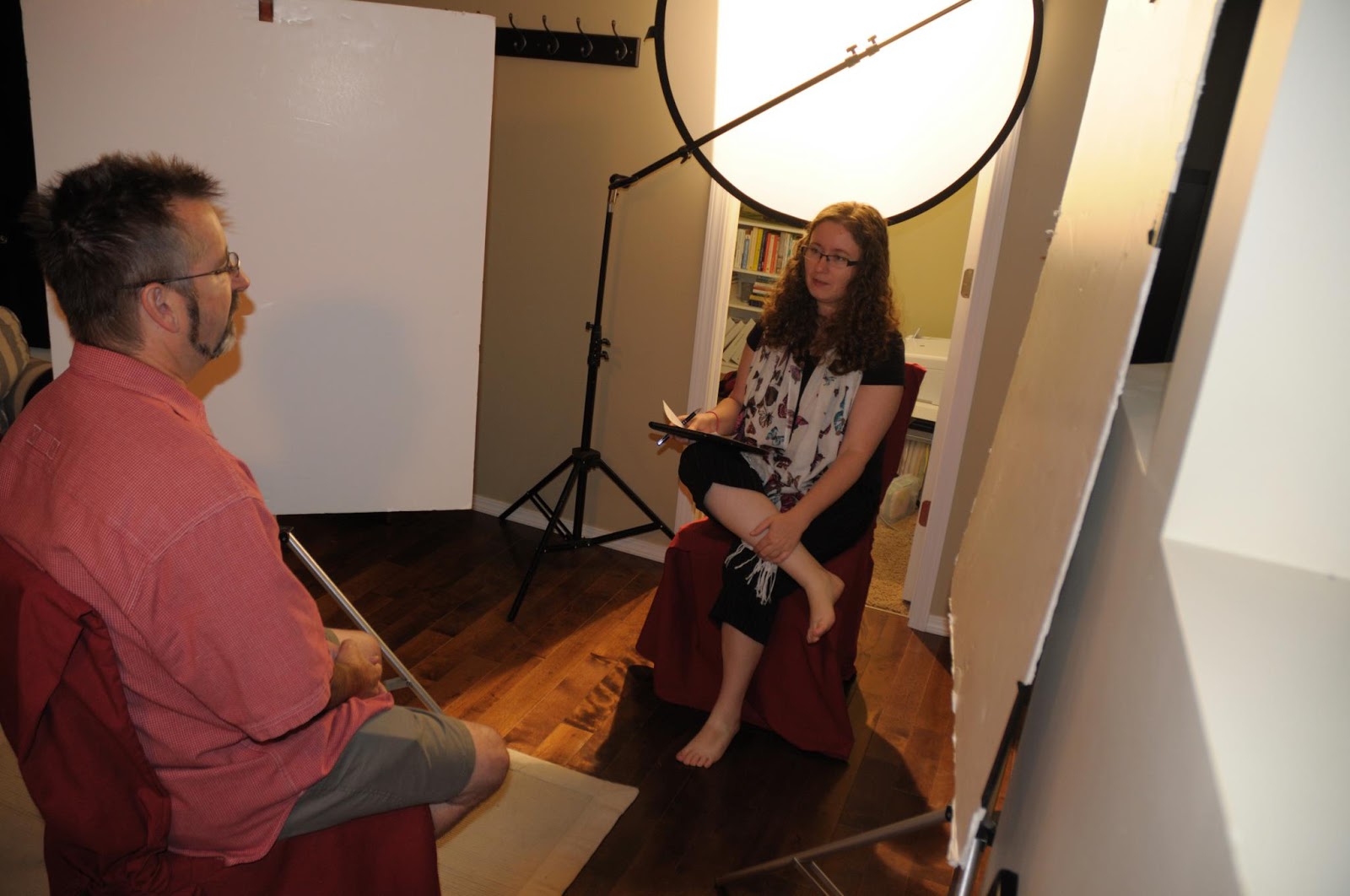
Kelly-Anne Riess with Jim Dixon. Photo: Thomas Bartlett.
Interviewing Jim Dixon, former Moose Jaw city councillor. 

Back in the day, Jim was one of several individuals who investigated the rumour of  underground tunnels in Moose Jaw and if they might have been used for bootlegging. Removing a manhole cover in the street led to the discovery of one such hideaway, said Jim, who believes Al Capone was likely in Moose Jaw.